|
An Unfair Aspect of the Western Approach to the Kurdish Case in Iraq |
S O İ T M Iraqi Turkmen Human Rights Research Foundation
Date: October 23, 2006 No: Rep.61-J2306 |
|
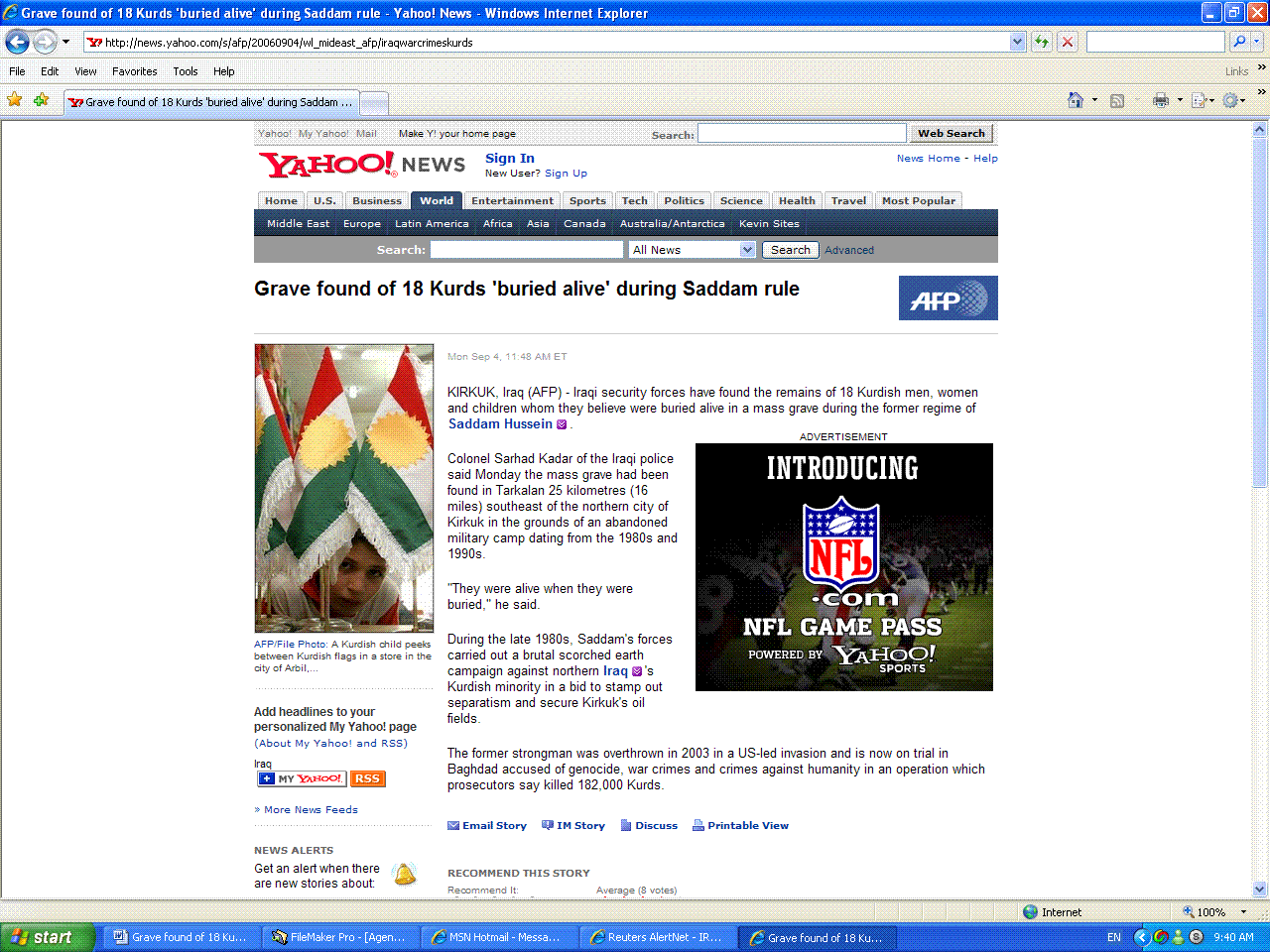
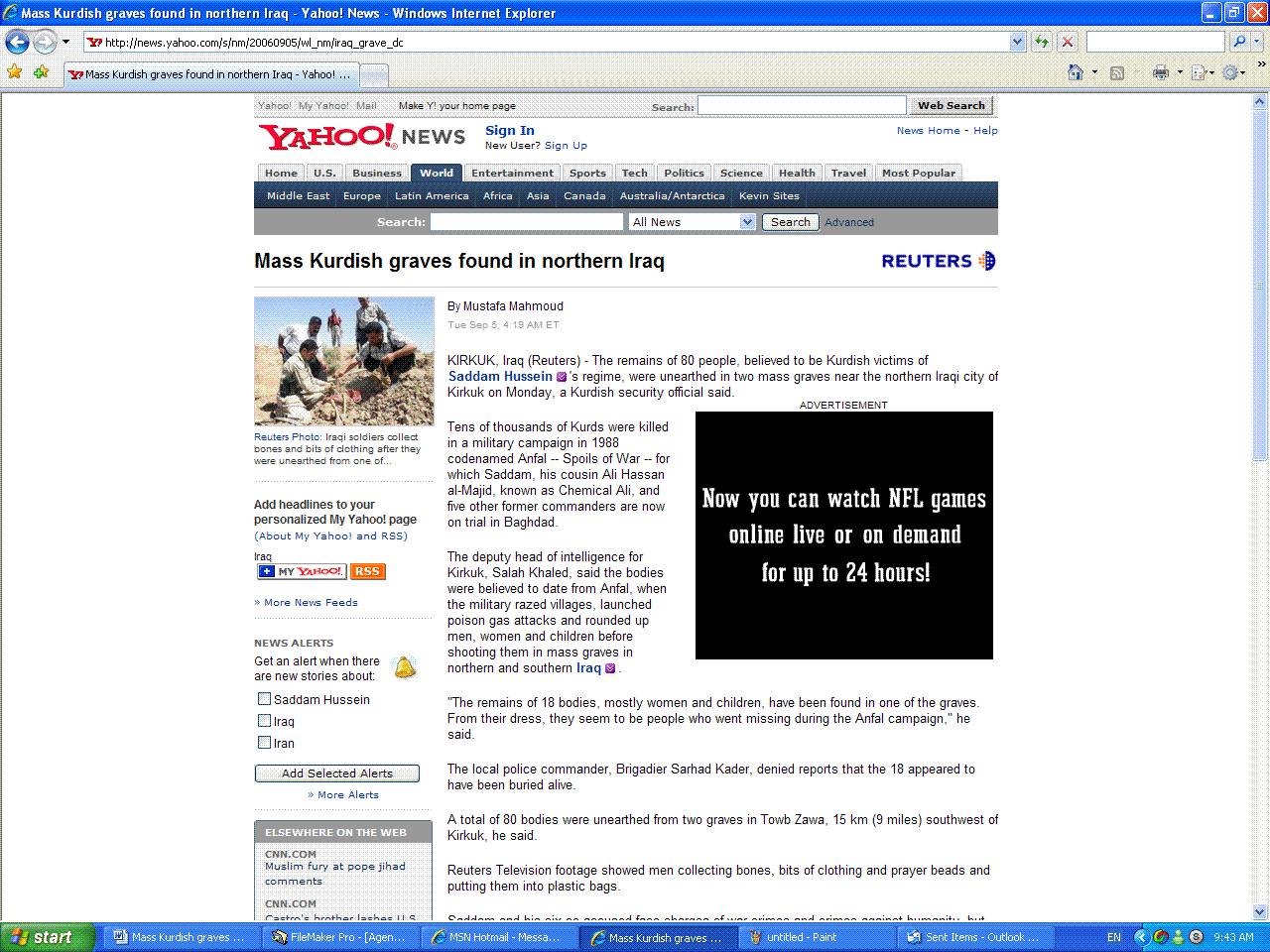
On 4.9.2006 and 5.9.2006, the two top international media Agency France Press and Reuters published 2 items of news about Kurdish mass graves in Kerkuk villages, Turkalan and Top Zawa.
Under the title ‘Grave found of 18 Kurds 'buried alive' during Saddam rule’, Agency France Press stated that 18 remains of Kurdish were found in Turkalan village (25 km) of Kerkuk.1
Reuters announced in their news, an item titled ‘Mass Kurdish graves found in northern Iraq’ mentioned that 80 bodies were 'buried alive', With clothing, possible Kurdish victims, were found in 2 mass graves in the village of Top Zawa (15 km) of Kerkuk city.2
The accuracy of this news was investigated and it became clear, that no such graves were found in these two villages at these dates: · The Wiseman and inhabitants of the two villages had no idea whether such graves were found. · The majority members of the Kerkuk city council have never heard such rumors. · The Turkmen and the Arab politicians of Kerkuk denied such findings.
One of the inconsistencies in the Reuters news is that although they say in the body of the article that it is possible that the victims were Kurdish, they state in the title that the bodies are Kurdish.
Turkalan and Top Zawa villages and Tuz Khurmatu district, Taze Khurmatu and Daquq sub-districts, and the villages of Yaychi, Kumbetler, Bulava … etc constitute the group of Turkmen towns to the south and west of Kerkuk city. These villages (Turkalan and Top Zawa) are located about 13 kilometers to the south west of Kerkuk city on either side of a motorway. The population size of Turkalan is reported to be about 350 families. As the Kerkuk province had been exposed to Kurdish settlement since decades from both the east and the north, the village of Top Zawa received a large number of Kurdish settlers, while the other villages remained almost purely Turkmen with some Arabic families who came from the west. During the occupation, in 2003, the Kurds constituted 50% of the Top Zawa. Under the strong Kurdisfication3 policy of Kerkuk province the Kurds came to dominate the population of this village (Top Zawa).
Large numbers of Turkmen inhabitants in these towns belong to the Shiite sects and the massacres during the suppression of the uprising in 1991 by the Ba’ath regime, in the Turkmen towns (Tuz Khurmatu, Taze Khurmatu, Daquq and even in Turkmen Sunni town of Altun Kopru) in Kerkuk province are notorious. Unfortunately, these have not got the same attention and interest of western media as the massacres that happened in Kurdish regions around that time and were covered extensively by the media.. 4
Moreover the Turkmen, Arab and Kurdish inhabitants of these regions are dressed similarly in traditional clothes. It is difficult to differentiate between them and distinguish the ethnicity of victims from the external features.
These news items were published: · Several days after Barazani (31.8.2006) ordered to ban the Iraqi national flag from governmental buildings in Kurdish region.5, 6 · During the trial of former government members for the so-called Anfal campaign and chemical bombing of Halabja.7
Taking into account that the Iraqi case with all its aspects particularly the Kurdish dramas and overreaction which attracts the attention of the international community and the media, the synchronization of these events with the publication of the aforesaid false news should have never have been considered as benign. In such cases: · This provides support for Barazani’s divisive action and it neutralizes the feelings of anger toward him. The fact is that he claims an immense and vast deal of Iraqi lands. · This diverge the attention of the international community from the important ‘inadequacies’ in the trail of so-called Anfal campaign. It is worth noting that the mass graves which are found in all Iraq account for no more than several thousand bodies of Kurdish people, while western literature has set the number of victims to be almost between 50 – 200 thousand.8, 9, 10
Sustained presentation of large numbers of highly dramatized stories and supportive news in favor of the Kurds to the western societies has resulted in a huge amount of kindness, sympathy and solidarity with the Kurdish case.
This began with the English mandate officers, (Hay, Longrigg, Edmonds, Soane …) after the First World War, who exerted British authority in the region and wrote narratives about years of military ruling in the context of their national policies. Later on, the Kurdish case attracted a significant number of extremist supporters from the international journalists.11 The report of the Human Rights Watch about the so-called Anfal campaign,12 which lack the simplest requirements of a scientific studies, gives an illustration of the radical supporters of the Kurdish case among the International Civil Society Organizations. The big mistakes which Dr. Leezenburg and Professor Carole A. O'Leary made in the favor of the Kurds shows involvement of the western academics with the fans of Kurdish case. As a result, all the western communities were influenced.11
No doubt the huge increase of sympathy for the Kurdish case has created great hatred for their appointed oppressors. In such circumstances, positive prejudices towards the first group and negative prejudices towards the second group were not avoidable.
This resulted in: · Gaining information from the Kurdish sources without investigation.13 · The Kurdish authorities (politicians, writers, Press) learned to spread the methods of introducing false information into western literature: § Publication of large numbers of inaccurate information about the geography of Kurdish regions and their suffering and tragedies: o The counterclaims are disbelieved and ignored o The several hundreds of Halabja victims has been amplified to 5 thousands o The several thousands of Anfal campaign victims had been inflated to 180.000 – 200.000, in the western publications and of international Human Rights Organizations o The Turkmen and Assyrian cities are considered to be Kurdish historical cities.11, 14, 15 o The suppression of these two communities and other groups by the Kurdish parties and militant Pashamarga in the north of Iraq are tolerated and forgotten16-18 · Other communities in the region were deprived of the awareness of the western communities, such as Turkmen, Christians …… etc. · Mobilization of great support (political, economical, moral, and armed) from the west for the Kurdish case and deprivation of support for communities and countries, which are accused.
This huge support played important role in the institution of the Safe Haven for the Kurds, when they were exposed to attacks by the dictatorial Ba’ath regime in 1991. The sufferings of other communities continued. Getting the absolute support of the USA after the occupation, the oppressed Kurds have been converted to oppressors of the other Iraqi communities: Turkmen, Assyrian, Shabak18 and Yazidis.19
Being presented with huge amounts of information in favor of the Kurds, the western writers omitted writing about the crimes of the Pashmarga militants of Barazani and Talabani which were committed in the north of Iraq during the Kurdish rebellion in the early 1960s until early 1990s: During these decades, · Thousands of Iraqi soldiers were killed or thousands of Iraqi families have a son, a father or both of them killed by Kurdish militants during the following military operations: § When the Iraqi army fought to return large regions in the north under the control of the state. § During the attacks which Kurdish rebels achieved on o Military camps and police stations. o The Iraqi troops at the front and when they were moving toward the battle fields during Iranian attacks o The roads between the major northern cities. For decades, all the roads in the Northern provinces were paralyzed due to the Pashmarga attacks and Kidnappings: Sulaymaniyya – Kerkuk – Erbil – Mosul – Duhok, even the Kerkuk – Baghdad road. Traveling was officially not allowed on these roads after 16:00 o’clock, particularly for the soldiers. · Hundreds of teachers, doctors and staff were killed. · The infrastructure was repeatedly attacked and destroyed: Electricity and water centers, hospitals, schools and municipalities.
Reviewed for English Language by Mohammed Kelenchy
References: 1. Agency France Press, ‘Grave found of 18 Kurds 'buried alive' during Saddam rule’, http://www.turkmen.nl/1A_soitm/AFP_falsenews.GIF 2. Reuters, ‘Mass Kurdish graves found in northern Iraq’, http://www.turkmen.nl/1A_soitm/Reuters_falsenews.GIF 3. SOITM report, “The extent of Kurdification of Kerkuk region”, http://www.turkmen.nl/1A_soitm/Rep.3-A1106P.doc 4. ITF, “Assimilation and Massacres applied against the Turkmen in Iraq” http://www.kerkuk.net/eng/index.asp?id=3059&katagori=1&s=detay 5. KRG, Barazani’s declaration of 31 August 2006, http://web.krg.org/articles/article_detail.asp?LangNr=14&RubricNr=&ArticleNr=13293&LNNr=35&RNNr=69 6. BBC, Barazani’s declaration of 31 August 2006, http://news.bbc.co.uk/hi/arabic/middle_east_news/newsid_5307000/5307370.stm 7. Aljazeera, “Saddam trial to start on Monday” http://english.aljazeera.net/NR/exeres/54F53685-C53C-45DA-B0B8-143509D84008.htm 8. women war peace, “Gender Profile of the conflict”, http://www.womenwarpeace.org/iraq/docs/iraq_pfv.pdf 9. Joe Sterling, “Saddam facing poison gas charges”, CNN, http://www.cnn.com/2006/WORLD/meast/08/20/saddam.trial/index.html 10. David Chandler, “Saddam's trial: playing the genocide card”, http://www.spiked-online.com/index.php?/site/printable/294/ 11. SOITM report, “The Western Intellectuals fall collectively in Error”, http://members.lycos.nl/soitum/W_intellectualsP.pdf 12. Human Rights Watch, “Genocide in Iraq: The Anfal Campaign Against the Kurds” http://www.hrw.org/reports/1993/iraqanfal/ 13. In his article Dr. Leezenberg transfer all what he heard from the Kurds as reliable information, as a result he commits a great mistake. “The Shabak and the Kakais: Dynamics of Ethnicity in Iraqi Kurdistan”, http://www.kurdishacademy.org/english/articles/articles-007.html 14. SOITM report, “The Turkmen Reality in Iraq: Kerkuk is not Kurdish City” http://www.turkmen.nl/1A_soitm/Art.7-B0306.doc 15. Press Releases, “Assyrian International News Agency”, http://www.aina.org/releases.html 16. SOITM report, “Violation of Human Rights of the Turkmen of Iraq”, http://www.turkmen.nl/1A_soitm/OSt.49-G3006.doc 17. AINA Press Release, “Kurdish Militia, Iraqi Police Terrorizing Assyrians in North Iraq, http://www.aina.org/releases/20060706111253.htm 18. AINA Press Release, “Kurds Block Assyrians, Shabaks From Police Force in North Iraq” http://www.aina.org/releases/20060624123753.htm 19. AINA Press Release, “Iraq's Yazidis Face Repression and Assimilation”, http://www.aina.org/reports/yezidiscpt.pdf |
|