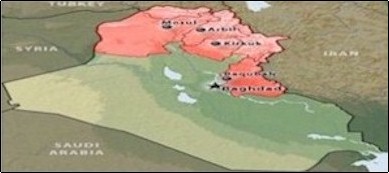
Immense lands which the Kurdish constitution includes
in Kurdish region
|
Discrepancies
in the Kurdish constitution disregard feelings of the Iraqis
Date: July 13, 2009
No: Rep.17-G1309
The constitution of Kurdish region is described by Sunni and
Shiite Arab parliamentarians as running counter to Iraq's national constitution. It
has created outrage among Arab and Turkmen political
factions. Chaldeo-Assyrian politicians say that it undermines their
national interests. The Yazidi parliamentarian condemns it. The Shabak’s deputy
considers it challenging the feelings of the Iraqis. Almost all non-Kurdish
Iraqi politicians have criticized it, even several Kurdish politicians.
According to Prime Minister al-Maliki, it is provocative, upsetting and risks
damaging relations. The Obama administration has also
appeared surprised and troubled by it.
Since the occupation of Iraq in 2003, Iraqis have been
engaged in confronting numerous critical challenges. Meanwhile, the Kurdish
authorities have been wholly engaged in collecting interests that in many
occasions are at the expense of Iraqis and Iraqi state. Noting worth that the
Iraqis were in an awful situation, due to 12 years of economical embargo during
which they suffered from hanger and its catastrophic outcomes, fortunately, the
Kurdish region averted that disasters.
Benefiting from the absence of centralized state power and
lack of experienced opposition politicians, with the backing of the occupation
forces, the Kurdish actors imposed their interests on the Iraqi state’s
constitution. The result has been the drafting of an internally inconsistent
constitution that weakened the Iraqi state.
Serious restrictions on the power of central state
authorities, contradictory articles, vague terminology, granting independency
to the federal authorities in many important state’s power, the living of
future decisions in non-treated fields to the regional authorities and the
sharing of the regional governments in almost all the authorities of the
central government have meant that the Iraqi constitution has lost many of its
federalist characteristics. This has, at the same time, damaged the influence
and workability of the state as a whole.
Moreover, despite the enormous advantages that the Kurds
obtained from the Iraqi constitution, the Kurdish authorities continue to
violate its articles. Today, it is clearly visible to the international
community that the Kurdish authorities are the major obstacle to constitutional
amendments, which according to article 142 of the Iraqi constitution, should
have been initiated in the four months following its adoption in 2005.
In addition, the recently published Kurdish constitution
(KC) contains all the organs and mechanisms of an independent state, it:
A.
Risks the Ignition of existing animosities and decreases the
opportunities for reconciliations.
B.
Clarifies what is a continuation of the opportunistic
attitude of Kurdish actors and their nationalist agenda.
C.
Shows clearly the expansionist attitude of the ruling
Kurdistan Democratic Party and Patriotic Union of Kurdistan.
The followings are discrepancies in the Kurdish constitution:
A.
Introduction
i.
The Kurdish nation and the Kurdish country are purposely
stressed. Furthermore, it stresses the creation of a united Kurdistan,
which doesn’t exclude neighboring countries.
ii.
It details the suppression of the Kurdish people by
successive Iraqi governments, and glorifying the braveness and fighting of
Kurdish rebels, whilst ignoring the Kurdish Peshmerga militias that attacked
the Iraqi state for decades and killed thousands of Iraqi soldiers. Thousands
of Iraqi children were subsequently orphaned and women widowed.
Selections from Introduction: “We the people of Iraq’s
Kurdistan” “valuing the leaders and the symbols of the liberation movement of
Kurdistan, who strugglers, the Peshmerga, its immortal martyrs and their
sacrifice for our freedom, safeguard our dignity, defend our country and call
for recognition of our right to self-determination by our absolute free will,
and remaining loyal to the message, values and objective for which they were
martyred, namely to establish a civilized Kurdistan community, -----------,
releasing the energy of its generations to establish Kurdistan as unified
homeland for all, -----------.“
B.
Article 2,
i.
Item 1, without any historical bases the constitution
wrongly defines a region called Kurdistan and
includes vast Iraqi lands and large numbers of districts.
Item 1: “Iraq’s Kurdistan is a
geographical and historical entity constituting Duhok province with its present
administrative boundaries, and the provinces of Kerkuk, Sulaymaniya, Erbil, and
the districts of Akra, Shakhan, Sinjar, Tilkeyf, Kara Kus and the sub-districts
of Zummar, Ba’ashiqa, Eski Kelek from the province of Nineveh, and the
districts of Khanaqin and Mendeli of Diyala province, but with the boundaries
of 1968”
ii.
Item 2, despite that Article 140 of the Iraqi constitution
lost its applicability; the Kurdish constitution demands its application.
iii.
Item 3, prohibiting Creation of regions, it contradicts with
the Iraqi Constitution and discovers the double standard of the Kurdish actors,
who strongly asks federalism for Iraq but refuse it for their regions.
Item 3: “the establishment of new (federal)
regions inside the boundaries of Kurdistan
region doesn’t be allowed”
C.
Article 3,
i.
Item 1 clearly rejects the authority of the Iraqi
Constitution, except those given in Article 110.
Item
1: “Authority is
sourced from the people, who are the base for its legitimacy, and authority
must be exercised through its constitutional institutions. The Kurdistan
constitution and laws have sovereignty and superiority over all the laws which
are made by the Iraqi government, excluding the exclusive authorities of the
federal government provided in Article 110 of the Constitution of the federal Republic of Iraq”
ii.
Item 2
almost completely rejects the authority of the central government, even
that of Article 110 of the Iraqi Constitution.
Item
2: “Application
of Article 110 of the Iraqi Constitution, which is related to the exclusive
authorities of federal law, does not detract from the sovereignty and
superiority of the Constitution and laws of Kurdistan region, and does not
limit the powers of regional authorities contained in article in Article 115
and Item 2 of the Article 121 of the federal Constitution”
D.
Article 7,
i.
The Kurdish Constitution leaves the possibility open for
separation from Iraq
and determines stipulations for separation.
Article 7: “The
people of Iraq’s Kurdistan
have the right to determine its fate and the people of Iraq’s Kurdistan chose by free will to be
included as a region in the federal Iraq, as long as the federal,
democratic, parliamentary and pluralistic system and individual and collective
human rights are guarded, as is detailed in the federal Constitution”
E.
Article 8,
i.
Item 1 gives absolute power to the so-called Kurdish
Parliament to hold international treaties and conventions contradicting Item 1
of the Article 110 of the Iraqi Constitution
Item
1: “the
international treaties and conventions which the Iraqi government holds with
any state or foreign party touching the status of or rights of the region of
Kurdistan, will be implanted within the region when the parliament of Iraq’s Kurdistan
accepts it by absolute majority of its members”
ii.
Item 2 grants the right to the so-called Kurdish Parliament
to reject various international treaties and conventions that the Iraqi state
holds.
Item
2: “the
international treaties and conventions which the Iraqi government holds with
the foreign states will not be applicable in Kurdistan region, if the
parliament of Iraq’s Kurdistan does not accept it by absolute majority of its
members, excluding the exclusive authorities of the federal government provided
in the Article 110 of the Constitution of the federal Republic of Iraq”
F.
Article 9,
i.
Item 1 requests a share from all types of incomes of the
Iraqi state for the Kurdish region, while Item 1 of the Article 17 keeps the
incomes of Kurdish region for the Kurds only. This is supported by Item 7 and 9
of Article 74.
Item
1: “the region
has basic constitutional rights against the federal authorities in:
A fair share from the federal
incomes of international grants, aids and loans according to the principles of
equivalency and population proportion, taking into consideration the policies
of genocide, arson, destruction and denial to which the people of Iraq’s
Kurdistan were subjected during the years of former Iraqi governments, in
accordance with the Article 106 and 112 of the federal Constitution”.
ii.
Item 2 requests fair Kurdish participation in administration
of the Iraqi state, various missions, fellowships and delegations and regional
and international conferences. The participation of Iraqis in the Kurdish
region is ignored.
Item
2: “According to
the principles of equivalency and the population proportion, there should be
fair participation in the administration of different federal institutions of
state, missions, scholarships, delegations to regional and international
conferences, and conferring career degrees to the peoples of the region in the
federal offices in Kurdistan region in accordance with the Article 105 of the
federal Constitution”
G.
Article 10 allows the Kurdish authorities to continue
absorbing Kerkuk city into Kurdish region and to retain it as a capital.
H.
Article 13 clearly contradicts with Item 3 of the Article
110 of Iraqi Constitution and gives right to the so-called Kurdish Parliament
to enact fiscal and custom laws.
The Iraqi Constitution presents
vague information (Item 3 of Article 110 and Item 1 of Article 114) about who
will manage custom revenue. Item 3 of Article 110 considers it the exclusive
right of the central government, but in Item 1 of the Article 114 shares it
with regional authorities.
Article
13: “Nor can any
fee or tax be imposed, modified or exempted in Kurdistan region without
approval of the enacting laws in theKurdistan
parliament”
I.
The underground wealth law which the Iraqi Constitution
holds the central government as the major organizer is vaguely presented in
Item 1 of the Article 17 in the Kurdish Constitution. It holds the Kurdish
authorities as the organizers of Hydrocarbon law in Kurdish region.
Item
1: “Resources
and public sources of natural wealth and surface and underground water and
unexploited minerals and quarries and mines are the public wealth whose
exploitation and administration are organized by law to preserve it for the
interest of present and future generations”
J.
Item 1 of the Article 18 of the Kurdish Constitution
regulates the executive, legislative and judicial powers without consideration
of the Iraqi constitution, while Item 1 of the Article 121 states that
regulation of aforementioned powers should be in accordance with the Iraqi
constitution.
Item 1: “Legislative, executive and
judicial authorities of Kurdistan region abide by the fundamental rights of
this Constitution considering its basic provisions, and these should be applied
and implemented as of being the fundamental rights of citizens of Kurdistan”
K.
Item 2 of the Article 23 holds the central government of Iraq to
compensate from the Iraqi budget the victims of Kurdish uprisings against the
successive Iraqi governments, while the Kurdish regional government obtains 17%
from the Iraqi budget, which is approximately twice the proportion of the
Kurdish population in Kurdish region. Noting that the central government will
also compensate large numbers of Iraqi victims out of Kurdish region from Iraqi
budget. If all victims of Ba’ath regime should be compensated from Iraqi
budget, then the victims of Kurdish region should logically be compensated from
the budget of Kurdish region.
L.
Article 35 of the Kurdish Constitution grants the right to
institute a federal region depending on the sect and ethnicity.
M.
Article 40 marginalizes the Iraqi Constitution and considers
the so-called Kurdish parliament the only legislative power.
Article
40: “the
parliament of Iraq’s
Kurdistan is the legislative authority and the reference to decide on the
crucial issues about the people of Kurdistan
region, its members are elected by direct secret free general vote”
N.
In the constitutional oath in Article 44 and Article 71, the
members of the so-called Kurdish Parliament swear to work only for the peoples
of Kurdish region.
O.
Item 1 of the Article 55 restricts the freedom of expression
of parliamentarians.
P.
In the constitutional oath in Article 63, the president of
Kurdish region and his deputies swear to work only for the peoples of Kurdish
region.
Q.
Article 64 leaves the door open for Masoud Barzani to rule
the Kurdish region for life.
R.
Article 65,
i.
Item 11 and Item 6 of the Article 70 empowers the president
of the Kurdish region with an authority of Prime Minster of Kurdish region.
ii.
Item 12 severely restricts the movement of the Iraqi army in
Kurdish region, which oppose the Item 2 of the Iraqi Constitution.
Item 12: “To allow (president of the region)
federal armed forces to enter the territory of Iraq's Kurdistan where
necessary, after winning the approval of Parliament of Iraq’s Kurdistan on the
entry of those forces with the identification of its functions and place and
duration of stay in the Territory”
iii.
Item 13 oppose the Iraqi Constitution and grant to the
Kurdish Peshmerga militias the characteristics of an army.
Item 13: “To send (president of the region)
forces of Territory’s guard the (Peshmerga) or the internal security forces to
outside the Territory with the consent of Parliament”
iv.
Paragraph 4 of Item 14 grants the authority to the president
of Kurdish region to marginalize the so-called Kurdish parliament, by
authorizing a non-elected prime minster.
v.
Item 21 oppose the Item 4 of the Article 121 of the Iraqi
Constitution by giving the right to President of Kurdish region to establish
offices for the Kurdish region out of the Iraqi embassies. At the same time
Item 14 of the Article 74 gives right to the council of ministers of Kurdish
region to establish such offices in the Iraqi embassies.
S.
Item 8 of the Article 74 violates the oil and gas law of the
Iraqi Constitution (Article 111 and Item 1 and 2 of the Article 112) and grants
the right of oil exploitation in Kurdish region to the so-called Kurdish
parliament.
Item 8: “Joint work with the Federal
Government to formulate strategic policies necessary for the development of the
wealth of oil and gas, combined with the consent of Parliament in everything
concerning the wealth of the Territory.”
T.
Article 77 violates Item 1 of the Article 121 of the Iraqi
Constitution by stating that the juridical authorities are independent in
Kurdish region.
Article 77: “The judicial authority is
independent in the territory
of Kurdistan, consists of
the Council of the judiciary, the Constitutional
Court, and the Cassation Court, and the committee of
judicial supervision, the public prosecution, and the courts in different
degrees, types of organs, and organizes composition, procedures and conditions of
appointment of its members and their accountability by law”
U.
Item 1 of the Article 111 demands a share from the Iraqi
underground wealth, while in the Item 4 opens the possibility to save the
income of the underground wealth for the Kurdish region only.
V.
Article 115 complicates any future authorities of the Iraqi
constitution on the constitution of the Kurdish region.
By refusing discussion of the Kurdish constitution in the
Iraqi parliament, the Kurdish authorities not only violate the Iraqi constitution,
they break the simplest bases of democracy and federal system.
The spirit of this constitution reflects the unproductive
and offensive policy of KDP and PUK since, which illustrates that they have not
rid themselves of pre-1991 rebel mentality. The Kurdish politicians irritate
feelings of the Iraqis, abases the Iraqi state. This trend has potentially
long-lasing grave implications for the whole Middle East.
|