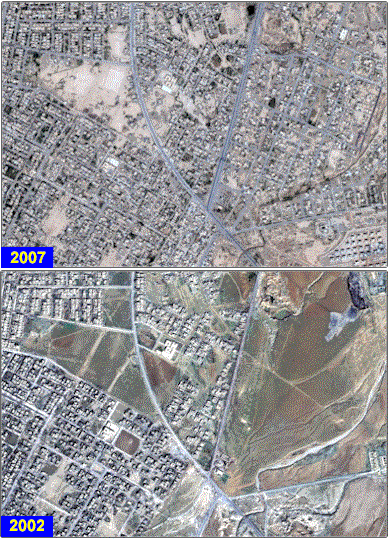
The most difficult time for the
non-Kurd components in the north of Iraq: Is it the disputed areas or
seized areas?
Date: 25 August, 2009
No: Rep.22-H2509
Unfortunately, Iraqis have lived for years
with the suffering of decades of dictatorship, war, economic embargo, and most
recently the U.S.
occupation. This long period has psychologically and physically exhausted Iraqi
people from all its communities.
Despite all these disasters that befell
Iraq, Iraqis continue to
rebuild their country and sympathizers among the global and regional powers
have been involved in helping Iraq
with moral and material aid to build the bases of the new Iraqi state. The
Iraqis are determined to build a democratic Iraq and a culture of human rights.
With the support and concern of the world, particularly that of the West, hoped
that they have the same goals and targets, they will establish the cornerstones
of democracy in the Middle East.
But the problems faced by Iraqis after
the occupation are numerous. The sectarian religious and ethnic racism are of
the most important of these problems. It was the cause of imbalance, political
instability and insecurity, and had an effective role in economic instability,
which negatively impacted all areas of daily life.
The religious sectarianism and tendency
for reprisals are considered the basic causes of the killing of dozens, or even
hundreds, of Iraqis every day for years during and after the U.S.
occupation. At a time when national and international efforts are concentrated
on stopping the bloodshed in central Iraq,
there continue to be systematic violations of human rights in those areas of
northern Iraq
under the control of the Kurdish parties, backed by the Peshmerga militia and
security units.
In northern Iraq live the majority of country’s
diverse ethnic and religious communities: Shabaks, Yazidis, Chaldo-Assyrians,
Turkmen, Kurds and Arabs. Regardless of their respective sizes, the standard of
living of everyone was approximately equal and all suffered the harshness of
the former political system. But after 1991, and particularly after the U.S.
occupation in 2003, the balance between these components was disturbed.
When the Kurdish Safe Haven was set up,
it gave rise to a large gap in the economical, political and even cultural
potentials between the Kurdish citizen on one hand and members of other Iraqi
communities on the other hand. The
result led to the hegemony of the Kurdish racist political parties in northern Iraq.
The most important factors that led to
the imbalance between the components in northern Iraq after 1991 are:
Ö
While
non-Kurdish communities were subjected to decades of suppression, and were
unable to directly challenge the Ba’athist Government, the Kurdish community
obtained material and moral support from regional and western powers,
facilitating their domination of the reins of power in the northern region.
Ö
Establishment
of the Kurdish Safe Haven excluded other Iraqi components whilst handing its administration
to the Kurdish tribal and militia-backed political parties which politicized
the security services and led to the marginalization of the non-Kurdish
communities.
Ö
Independent
access by the Kurdish nationalist parties to a large proportion of Iraq’s
national income and their control of revenue from the northern border gate
provided the Kurdish authorities with additional sources of finance and
strength.
The policy of the Kurdish parties to
glorify Kurdish race has led to the preparation of curricula based on incorrect
historical and geographical information that encourages the development of a
fanatic generation of Kurds ready to quarrel against any people they feel to be
threatening their ethnic goals. In these circumstances, Kurdish militias (Peshmerga),
Security Services (Asayish) and intelligence agencies (Parastin)
were built with the same concepts.
By the time of the 2003 occupation, the
Kurdish people had already gained a sense of injustice that their fatherland
has been occupied by others and the Kurdish parties and people were convinced
of the Kurdish nature of northern Iraq, and in particular the city of Kerkuk.
Despite historical and academic sources offering a different opinion, they
believe they have the historical right to build their country on vast Iraqi
lands. (See references below)
Kurdish man had developed an
overwhelming desire to establish a Kurdish state at any cost. The absolute
support of the occupation forces to the Kurdish parties and the absence of any
authority or rule of law due to demolition of the Iraqi state became as a
catalyst for the implementation of these base-less aspirations by the Kurdish
authorities. The material and moral support of the West, resulting from
sympathy to the Kurdish case after the latter were targeted for their fighting
against Saddam Hussein, played a great role in strengthening this rush.
Up to this stage the Kurdish parties
and their cadres lacked experience and were characterized by toughness,
tribalism, intolerance and inefficiency after having been fighting the Iraqi
state amid the rugged mountains for decades. These parties have withdrawn all
of these specifications with them into the period of Safe Haven in early
nineties and into the after occupation period.
Thus began the most difficult time for
the millions of Iraqi non-Kurds who form the majority in northern Iraq. The
Kurdish political parties, militias and security services took control of most
of the state's civil administration, security, and military departments. Under
the supervision of the occupation forces, their control was extended to include
more than 75% of the province of Mosul (± 3 million inhabitants), 20% of the
province of Salah al-Din (± 1 million inhabitants) and 90% of the province of
Kerkuk (al-Tamim) (830,000 inhabitants) and about 50%
of the Diyala province (1.37 million inhabitants), whilst several millions of
Arabs, Turkmen, Yazidis and Shabaks are living in these areas. The estimated
size of the Kurds in this vast area is thought not to exceed one million inhabitants.
Kurdish control also overwhelmingly
dominated those lands outside the Kurdish region that are at the root of plans
to annex them to the Kurdish administration.
There is pressure on millions of non-Kurdish Iraqis to change their
nationality with the aim of changing the demography of the region – aided by
the resettlement of Kurdish families and ethnic cleansing.
The first days of occupation
In the absence of state institutions,
the looting and burning of government departments began and spread to banks,
universities, municipalities and community radio, television and even
hospitals. Peshmerga militias seized the
wheels of government, of the Ba’ath party and in many cases of non-Kurdish
inhabitants. Arabs were forced to leave their villages and had their property
appropriated. Large numbers of machines, vehicles and government documents were
transferred to Sulaymaniya, Duhok and Erbil.
The Kurdish militia, supported by
political parties, also started seizing government buildings in these vast lands,
and especially in Kerkuk, sharing these properties among themselves. Many of these buildings were turned into
offices or housing for the Kurdish families brought to the region as part of
the Kurdification process.
Demographic change
State institutions
Almost all of the Iraqi state
institutions have been dismembered and the Iraqi citizens have been
psychologically and economically exhausted, making it easier for the Kurdish
parties and militias, which were well-armed and organized to enter and extend control
over these areas in the four provinces and all of its governmental
institutions, under the supervision of the occupying forces. The partisans and
members of Kurdish Peshmerga, who did not have the minimum degrees of
education, received the top posts in the cities, districts and sub-districts.
Consequently, they have been appointed as district and sub-district managers
and mayors. Thus, most managers of the state offices come from the ethnic Kurds
and they took control of the city councils. Tens of thousands of Kurds had been
appointed in the government offices in these vast areas of northern Iraq, where the
number of state employees has increased twofold in some regions.
Kurdish nationalism and party affiliation
has been adopted the basis for appointments.
By these means many non-Kurdish inhabitants were forced to work for the
agendas of Kurdish parties away from their parties. Additionally, Kurdish
parties seized large numbers of jobs in the Iraqi state, which are
disproportional with their size. From the total of 165 senior posts in the Iraqi State,
the Kurds hold 65 posts.
Kurdish parties with militias has ruled
the northern regions of Iraq in the full absence of state institutions while
the concern of the international community and Government of Iraq remained with
the fighting and bleeding in the center of the country. In the midst of these
circumstances, the rebuilding of all the institutions of the state including
the military, security and police systems, was carried out with the intention
of ‘Kurdifying’ the institutions. The staff of the civil service was in many
accusations doubled and in addition to the large numbers of Kurdish Peshmerga
militias, distributed throughout the governorates, the
overwhelming majority of the two Iraqi military brigades stationed in Mosul were Kurdish.
In Kerkuk, the security system has been
replaced by hundreds of Kurds, brought from Sulaymaniya, Erbil
and Duhok. The majority of officers and
members of the police came from the Kurdish parties in Kerkuk province and they
control of these devices in most of other regions. The Kurdish parties seized
all weapons of the dissolved Iraqi army in the northern regions, which were
about more than a quarter of the strength of the total weapon of Iraq -
amounting to hundreds of thousands of light and heavy weapons, including tanks
and many types of anti-aircraft missiles and mortars, all of which were
transferred to the Kurdish provinces.
Two important factors led to replacement
of large numbers of qualified personnel in these vast areas by non-qualified
Kurds:
Ö
The
adoption by Kurdish political parties of a concerted Kurdification policy.
Ö
The
fleeing of large numbers of staff who previously held key positions in
government offices .
There was therefore a great need to
find qualified replacement personnel but the failure of the Kurdish
administration to find such personnel has led to the majority of appointments
being made to non-qualified Kurdish staff, who in many cases has not studied in
either primary or secondary school. Taxi drivers consequently became police
chiefs, while graduates of the Institute
of Agriculture became
directors in unrelated government offices. Peshmerga militants who have not
received any formal training or education held the posts of manager in
government offices and the graduates of a primary school became officers in the
army, police or security forces.
Hundreds of Kurdish party headquarters
backed by militias and security forces have been spread throughout the cities,
districts and sub-districts. Kurdish parties spent large sums to recruit a
large number of collaborators from other nationalities.
Iraqi elections were held in these vast
areas under the control of the Kurdish parties and their militias all of whom
do not hide their insistence on the Kurdishness of
these areas and of the need to seize it by force if necessary. The population
number of Kerkuk province at the day of occupation was 870,000 people. The
number of voters in this province became 800,000 in the elections of December
2005.
During the elections, the poverty of
non-Kurdish citizens was exploited to obtain their votes after paying symbolic
sums to them. Furthermore, large sums have also been paid to many of those who
hold important posts for their support for the Kurdish party’s agendas. After
using all kinds of manipulations and election frauds, the Kurdish parties won
in most areas, which increased their control on all key positions in
administration and decision-making mechanism in these areas. For example:
Ö
The
number of Kurds in Nineveh
province council was 31 out of 41 members. This was partially due to the Sunni
boycott.
Ö
In
Kerkuk province council, the number of Kurds is 24 out of 41 members.
Ö
In Erbil, the sets of provincial council were divided
equally between the two Kurdish parties
Ö
All
members of the City Council of Kifri are of Kurdish ethnicity
Ö
In
Khanaqin after intimidation and temptation, the representatives of other
nationalities in the city council joined to the Kurdish parties.
Kurdish migration
Kurdish parties started with the
beginning of the occupation to encourage hundreds of thousands of Kurdish
citizens to migrate to new areas that the Peshmerga had entered after the
occupation, frequently paying a sum or/and salaries to them. Those who held
high positions in the political parties or in Peshmerga militias, acquired
finances for the construction of their homes, which are built on the lands of
the municipalities, government or non-Kurdish peoples. Hundreds of family
members joined those who received new posts and dozens of new neighborhoods
have arisen in the cities of these vast areas. The number of Kurds and Turkmen
who were removed from Kerkuk by the Baath regime was estimated to 120,000 Kurds
but the bulk of those deported from Kerkuk were born in Sulaymaniya
or Erbil.
The Kurdified
administration forged ration cards and transferred population registration
records of the Kurdish people coming to the new areas, in particular that of
Kerkuk province. The newcomers were provided with the identity cards and
passports but attempts of the Kurdish parties to transfer the population
registration records of Shaykhan district to Kurdish Duhok province failed.
Thousands of staff and teachers from the province
of Sulaimaniya,
Erbil and Dohuk have
been appointed to teach the Kurdish language instead of Arabic. Elements of the
Peshmerga militias have been fixed in the many checkpoints that have been
developed on public roads between many cities like Erbil,
Bartalah, Shaykhan and Dohuk.
Thousands of Arab families left these
vast areas after the initial entry of Peshmerga militias, while other Arabs
left the region after animosity and hostility grew at the same time as the
Kurdish militia consolidated their control of the region. In Kerkuk province
alone about 25 villages were evacuated of which many had existed before the
Ba’ath regime.
Appropriation of lands particularly
that of government and inhabitants lands is considered a major characteristic
of the period after the creation of the Kurdish Safe Haven in these
regions, particularly after occupation. The Kurdish parties, which held for the
first time the administration of governmental offices in 1991, have lacked the
understanding of concept of a state and the management of its institutions.
Consequently, the newcomers from the mountainous regions supported by Kurdified
administration have captured vast lands belonging to municipalities, government
and inhabitants. The share of these
lands going to party members and militias was also enormous, for example, the
Barzani family seized on the territory of the entire Salah al-Din district.
Meanwhile, in Kerkuk province, the Kurdish families have seized on all types of
lands and large numbers of buildings. This resulted in the number of lawsuit
presented to the Property Claims Commission in Kerkuk province reaching over
40,000 individual cases, most of which related to Turkmen.
Other human rights situations
After occupation, the general situation
in northern Iraq
was characterized by:
- Absence of the rule of law and the forces which preserve it
- Absolute control of the Kurdish parties and militias, which are
characterized by:
a.
Non-democratic
tribal mentality
b.
Lack
of professionalism resulting from a lack of education and vocational training
c.
Tough
aggressive nature because of living in the harsh mountainous areas in a state
of a war, which lasted for decades
- The Iraqi State and the international community were
engaged to address the disaster caused by the fighting in central Iraq
- Iraq's other ethnic groups in the region were exhausted as a result of
the assimilation policies of former dictatorship.
- The absence of international human rights organizations and even
the United Nations and the lack of monitoring or follow-up has led to lack of registration and documentation of
large numbers of violations of human rights for a period of years.
Under these circumstances, although the
region did not face a conflict between Sunnis and Shiites, there have been
thousands of cases of intimidation, arrests, detention, torture in prisons,
kidnapping, assassinations, killings and loss of persons from non-Kurdish
ethnic groups and many others who oppose the policies of Kurdification. With
the lack of security, thousands of Yezidi, Shabak, Chaldeo-Assyrians, Turkmen
and Arab families migrated from the regions where Kurdish Peshmerga militias
were in charge of security. Today, it is estimated that 238 people were
kidnapped in Kerkuk and there are a lot of abductees who have not been counted.
In these vast regions, the Kurdish
security forces (Asayish) have converted the
buildings of Ba’ath party into the headquarters for Kurdish militias, where the
oppositions were detained. Hundreds of these offices are today scattered east
of Mosul city
and in the plain of Nineveh, working to suppress the non-Kurdish population by
all types of intimidations. In coordination with the headquarters of the
Kurdish parties, the security agents collect information on citizens and
prevent the Shabaks and Chaldeo-Assyrians from entering the city of Duhok and other regions
and target the Yazidis who reject the dominance of the Kurdish parties.
During the attempts of Kurdish militias
to control the district of Tal Afar, which was put in the map of so-called Kurdistan, the region was subjected to two destructive
attacks using all types of heavy weapons including tanks and helicopters. As a result, thousands of occupation troops
and Kurdish militias swamped the city causing 100,000 inhabitants to leave Telafer. The minor attacks, arrests, assassinations,
kidnappings continued for three years. Large numbers of populations are still
considered internally displaced.
In 2005, Kurdish militias broke into
Turkmen political party buildings and institutions, confiscating twenty-four
buildings including, fifteen schools, newspaper, print houses, local radio and
television stations and the headquarters of political parties. Turkmen living
in Erbil who were not loyal to the Kurdish
parties were denied work in government offices. The non-Kurdish inhabitants of
all the regions were forced to study Kurdish in schools.
Many Chaldea-Assyrian villages were
evacuated, tens of Yazidi politicians were arrested,
Shabak activists were assassinated, hundreds of leading Baathists
were killed and Turkmen lands were confiscated.
The Kurdish authorities recruited large
numbers of collaborators from other communities and used them to establish
parties and civil society organizations against their own national parties.
These collaborators were used in political companies. Many spied for Kurdish
parties. The votes of other communities were bought in the elections.
Names of the cities, streets and
buildings were changed from Turkmen or Arabic to Kurdish. The signboards in the
governmental offices were written in Kurdish, the non-Kurdish inhabitants
greatly suffered particularly in the hospitals.
Domination of the Kurdish parties on
the administration in these vast regions led to the revival of the Kurdish
neighborhoods and cities and retardation of the development in non-Kurdish
regions.
One of the most dangerous phenomena
that have begun to emerge in northern Iraq is the large differences in
standard of living and economic power between the Kurdish people on one hand
and the non-Kurdish people on the other hand. This phenomenon is attributed to
the following factors, which should be generalized to the vast regions which
the Kurdish militias controlled after occupation:
1.
The
appointment of hundreds of thousands of Kurds in areas occupied by the Kurdish
parties, after the occupation:
a.
In
government offices, for example,
a.
The
appointment of more than ten thousand staff in Kerkuk province, 90% of whom are of Kurdish ethnicity.
b.
About
two thousand Kurds were appointed in Kara Tepe sub-district.
c.
Thousands
of Kurdish teachers from Duhok were appointed in Mosul region.
b.
In
the Iraqi army, for example, more than 80% of the two Iraqi army divisions in Mosul are of Kurdish
ethnicity.
c.
In
security service and police, for example, almost all the security system in
Kerkuk province were replaced by Kurds in Kerkuk province
d.
Increase
in the number of Peshmerga militias, for example, the recruitment of tens of
thousands of Peshmerga militants in 2004 - 2005
e.
Appointments
in Kurdish regions, for example, being it is based on the party affiliation;
there are about million staffs in Kurdish regions who are also members of
Kurdish parties. In contrary, the number of non-Kurdish appointments is
severely restricted.
2.
Kurdish
authorities:
a.
Receive
13% of Iraq's
income since mid 1990s, while the other communities receive no share. Despite
the important decline in the number of Kurds in the three Kurdish provinces
after occupation, the Kurdish share increased to 17% of the total Iraqi budget
and other Iraqi communities have remained deprived of any share.
b.
Collect
massive sum from Khabour border crossing since 1991,
where almost all the Iraqi imports were entering.
3.
Kurdish domination on the governmental offices
in the north of Iraq
has brought another economic benefit to the Kurdish people. Since occupation
and in these vast regions, the Kurdified administrations gave thousands
projects to the Kurdish contractors who use the Kurdish officials and Kurdish
workers.
These are the developments in the north
of Iraq
since the occupation and for a period of six years, where the Kurds dominate
economy, civil, military, security administrations working to subdue the
non-Kurdish communities to contain their lands and to annex it to the Kurdish
region.
___________________________
References:
1.
Phebe Marr, “The Modern History of Iraq”, P. 9
“In recent
history, Kurds have been migrating from the mountains into foothills and
plains, many settling in and around Mosul in the
north and in the cities and towns along the Diyalah River in the south, but most Kurds still
live along the lower mountain slopes where they practice agriculture and raise
livestock”
2.
Edger O’balance, “The Kurdish
Revolt”, P. 33
“Right up until the end of the 19th
century the sight of a large tribal federation, with all its livestock, moving
across the mountains and plains of the northern parts of the Middle
East in search of fresh grazing, was both splendid and ominous -
as nomadic Kurds moved like a plague of locusts, feeding and feuding”.
3.
David McDowall, “A Modern History of the Kurds”, I.B.Tauris & Co Ltd Publishers 1996, London
& New York,
P. 144.
“The towns and
villages along the high road running from Mosul
to Baghdad were
mainly Turkish speaking, being Turkmen”,
“But, as the commission
noted, the Kurd ‘is taking possession of the arable and in “Kurdizing”
certain towns’ specially the Turkmen’s ones of the high road”
4.
William R. Hay, “Two Years in Kurdistan
1918 – 1920”, (William Clowes and Sons, Limited,
London and Beccles 1921), P. 81 – 83
“Dizai tribe descended from the hills about 3 centuries ago,
and occupied a few villages round Qush Tappah. In the middle half of the 19th century they started
to expand, and rapidly covered the whole country up to Tigris.
In the late 1920s, they constitute one third of the Erbil
district population.” “It is reported that less than a century ago trees and
shrubs were plentiful on the slopes of Qara Choq Dagh; when the Kurds came,
however, they were quickly taken for fire woods and no trace of them now
remains”
5.
Ibid, P. 10
“Mandali in fact was an ideal training ground. Four
languages were current in the district, and most of the townsmen could speak
all four. As children they learnt their mother tongue, Turkish, from their
parents, and the local Kurdo-Lurish dialect from
their nurses and the people of the hills, whither they were sent for the hot
weather. Subsequently they acquired Arabic from the men who tended their
date-gardens, and Persian from the merchants who visited their town and became guests
in their houses".
6.
George Keppel, “Personal Narrative of Travels in Babylonia,
Assyria, Media, and Scythia”, H. Colburn 1827,
Vol. I, P. 30
“Not many weeks
before we saw this Moolah, he was one of the
principal persons of Mendali, a Turkish town near the
frontier. In those days he was the bosom friend of Davoud
Pasha, "his best of cut-throats" and most willing instrument of
assassination”
7.
Ibid. P. 267
“From
the ferry we rode about 2 miles along the banks of the river, arrived at Bacoubah, our second day’s march. This appears to have been
a very considerable place, but has been laid almost entirely in ruins by the
army of Coords, under the command of Mohammad Ali Meerze”.
8.
Ibid., P. 276 - 281
“We
reached Shahraban at eleven o’clock P.M., and found
it almost entirely deserted. ---. We wondered through the desolate street, some
time without finding any house with inhabitants, till we came to a
caravanserai, where we met a man who told us that all the inhabitants had left
the place, which had been sacked and ruined by the Coords.”
“This town was, not many months back, one of the most populous and thriving in
the pashalick of Baghdad, now the whole population consisted
of about 3 families”
9.
Ibid., P. 290 - 291
“Our
tents were pitched to the north of the town. Kizil Rubaut,
in common with its neighbors from the vindictive spirits of its Coordish enemies”
10.
Ibid., P. 293
“In an
hour and a half we found ourselves at Baradan, which,
in common with other villages, has suffered from the inroads of the Coordish army”
11.
Ibid., P. 297
“Khanaki, which is of reputed antiquity, defines the
frontier of the Pashalick of Bagdad, and has met with
a fate natural to its unfortunate position between two rival powers. About two
years ago, it was taken by Mohummud "Ali Meerza, and must at that time have had its share of the
calamities of war”